Seeking to rescue those under the stress of IB

Monday, 21 April 2014

4.3 Theoretical Genetics

Genotype: the allele combination that expresses a specific characteristic
Phenotype: The observable characteristics as a result of the genotype (physical description of the genotype)
Dominant Allele: The characteristic of this allele is always present whether it is homozygous or heterozygous
Recessive Allele: The characterisitc of this allele is only portrayed when it is homozygous.
Codominant Allele: Alleles that share the dominance so that both of the characteristics are present
Incomplete dominance: neither allele is entirely expressed resulting in a mixture of the two traits. (A red allele and a white allele that are have incomplete dominance can result in a pink phenotype)
Locus: The position of a gene on a homologous chromosome
Homozygous: two identical alleles of a gene
Heterozygous: two different alleles of a gene
Carrier: Genotype consists of only one recessive allele that causes a genetic disease. Offspring can develop the genetic disease when possessing alleles that are homozygous.
Test Cross: Crossing an organism with a dominant genotype with a known homozygous recessive

Punnet Grid:
A genetic cross is often used to determine the genotype of the offspring using the known genotypes of the parents. A monohybrid cross can be used to find out what the genotype, for one specific gene, will look like.
A punnet grid is used to predict monohybrid crosses

  1. Designate one character that defines the alleles using a capital letter for the dmominant allele and the lower case version of the character as the recessive allele
  2. Determine the genotype and phenotype of the parent generations (P generation)
  3. Determine the genotype of the parental gametes as a result of meiosis
  4. Use the punnet square to determine the potential combinations.  
  5. Record the phenotype and genotype ratios of the offspring (F1 generation, first generation)
Some genes have multiple alleles such as blood type which possess three alleles. Alleles can be codominant, show incomplete dominance, or have . a dominance order (eg. allele A > Allele B > Allele C)
The alleles that determine blood type show codominance and multiple alleles. Codominace is usually written with an identical character to determine the recessive and dominant alleles and other superscript characters to show the codominant alleles.
     For blood types:
           I represents immunoglobin, a protein in blood
           A and B are used to name the co-dominant variables
There are three alleles in the blood typing gene.: IA, IB and i. The I and Ialleles are co-dominant and the i allele is recessive. 


Out of the 23 pairs of chromosomes that each human possess, 22 of them are autosomal; that is they are not sex chromosomes. The remaining pair will determine the gender. Females will have two XX chromosomes and males will have a X chromosome and a shorter Y chromosome. The genes for the male characteristics are found in the Y chromosome that can only be passed on by the father. If the spermatozyes contain the X chromosome then the offspring will be a girl, if it's a Y chromosome then the offspring will be a boy. The mother will always pass on a X chromosome.
The different sizes of the two chromosomes will prevent any crossing over or recombination from occuring during meiosis so that there will always be a 50% chance of a boy and a girl. The size differentials also means that the chromosomes are not homozygous and that genes will be absent on the shorter Y chromosome.  The Y chromosomes only contains a few genes such as the SRY sex determination gene and the genes for haemophilia and red-green color blindness are not present on the Y chromosome. 
In human females, only one X chromosome is active while the other is condensed as heterochromatin  that forms a condensed Barr body. 

Sex Linkage:
Sex linked genes refers to characteristics that are found on the sex chromosomes. These are usually found on the X chromosomes as the Y chromosome carries very few genes. Since males only have one X chromosome they are known as hemizygous, while females can still be heterozygous or homozygous because of the presence of two X chromosomes. 
Some recessive diseases that are found on the X chromosomes will be displayed in males because the gene loci is only present on the X chromosome and non-existant on the Y chromosomes. Therefore, there will not be any gene on the Y chromosomes of males. Any allele found on the X chromosome without a pair on the Y chromosome will be displayed whether it is dominant or recessive. Hemophilia and color blindness are examples of diseases only found on the X chromosome. Since males can only get this X chromosome from their mother then the mother must have been a carrier for the disease, if the mother was heterozygous for this trait, or have displayed the trait if the mother was homozygous for the trait. 
H - hemophilia negative, h - hemophilia positive
Carriers are individuals that possess a recessive allele for a disease that is covered by a healthy dominant allele.These heterozygous individuals (females) will not experience the condition but have a chance of passing on the alleles to the next generation. Males cannot be carriers for sex linked genes because the disease will be shown, but they can still pass on the trait to a daughter.  


4.2 Meiosis

Meiosis:
  • reduction of diploid cells into haploid gametes in the reproductive organs
  • organisms that are have two copies of each chromosome (homologous chromosomes) need to reduce it to only one copy so that the fertilisation of two haploid cells will create one diploid zygote. Homologous chromosomes have the same strucural features and all the genes are located on the same loci position. 
  • Meiosis is divided into two divisions. Meiosis I reduces a diploid nucleus into a haploid nucleus. Meiosis II separates sister chromatids before they are replicated in interphase
Process of Meiosis: See 10.1

Non-Disjunction: failure of chromosomes to properly separate can result in gametes with extra or missing chromosomes. this can occur during anaphase I (leading to four affected cells) or anaphate II (leading to two affected cells).

Down Syndrome: three copies of chromosome 21. A parent had two copies of chromosome 21, as a result of non-disjunction,  in addition to the one copy from the other parent.

Karyotype: Visual profile of the chromosomes within a cell. Chromosomes are arranged in their homologous pairs and arranged according to their structural characteristics.
Karyotyping is done by harvesting cells usually from the fetus or white blood cells of adults. Cell division is induced chemically and stopped when the chromosomes are condensed in mitosis. Chromosomes are stained, photographed then arranged according to its structure. Disorders can be found by looking at the chromosome number with disjunction or at the number of chromosomes that are present

Pre-Natal Karyotyping can be used to determine the gender of the child and to test for any chromosomal abnormalities such as down syndrome. This is done by amniocentesis or chorionic villus sampling. Amniocentesis can be done at week 16 of pregnancy with a 0.5% chance of miscarriage. A needle is inserted into the amniotic cavity in the uterus through the abdominal wall. A sample of the amniotic fluid with the fetal cells is taken. Choronic villus sampling can be done at the 11th week of pregnancy. A sample of chorionic villi, which also contains fetal cells, is collected with a tube that is inserted through the cervix

4.1 Genes and Mutations

Eukaryotic Chromosomes are made of DNA that wrap around histone proteins. These will be packed together to form chromatin which is the basic structure of the nucleosome. During prophase, these chromatin will condense to form chromosomes visible under a light microscope. Prokaryotic chromosomes are considered to be naked because there are no proteins used.

Gene: factor that controls the characteristic of the offspring passed on from the parent
Allele: a form of the gene that can differ from other alleles by one or a few bases. Alleles for the same gene will occupy the same locus
Gene Mutation: Changes experienced by the sequence of nucleotides (gene) that code for DNA.  Mutations can be caused by mutagens such as radiation, chemicals or by mistakes during cell replication
Point Mutation: A single nucleotide is replaced with another
Insertions: addition of one or more nucleotides
Deletion: removal of one or more nucleotides
Gene duplication/deletion: large segments of the chromosome are replicated or deleted
Inversion: chromosomes are found to be rotated 180 degrees
Translocation: parts of the chromosome are moved to another chromosome

Many mutations will only cause minor differences, but others can be extremely noticeable. New characteristics can be made with mutations, some harmful others beneficial.

Sickle Cell Anaemia is the result of a single base that has been changed to alter a mRNA codon found in transcription. The mRNA codon will code for a different amino acid and the formation of a different protein as well. The protein alters the structure of hemoglobin and red bloods into a sickle shape
The structure of the hemoglobin renders it insoluble and can no longer effectively carry oxygen. Patients will feel more tired due to the lack of oxygen. The sickle shaped blood cells can create blood clots that can cause many problems. These blood cells will also die more quickly resulting in a low red blood cell count. Sickle cell anaemia will only occur in people who are homozyous for the codominant allele. Those that are heterozygous will be resistant to malaria because of the one sickle cell allele.

DNA Structure

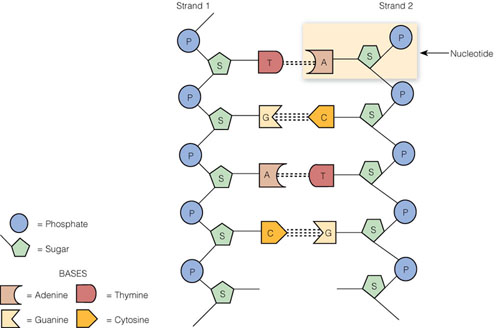
The nucleotides of DNA have: a sugar deoxyribose molecule, nitrogenous base (adenine, guanine, cytosine, and thymine) and a phosphate group. The purine bases have double rings and they are adenine and guanine. Cytosine and thymine are pyrimidine bases that only contain one ring.  Adenine will bind with thymine and guanine with cytosine. These nucleotides form a single strand through a condensation reaction and are connected via covalent bonds (phosphodiester bonds). . The phosphate group from the 5' carbon of a nucleotide will join with the hydroxyl group from the 3' carbon of the consequent nucleotide. A phosphodiester bond is the result and a water molecule is created since this is a condensation reaction. After several reactions, a long strand of nucleotides will form.
(The ' symbol is read as "prime." By writing 5' it is saying five prime. The sugar deeoxyribose consists of 5 carbon molecules with each "prime" simply referring to the specific carbon molecule. and its location. The phosphate group is hence attached to the fifth carbon while the hydroxyl group to the third carbon)
After two chains of nucleotides are formed, the nitrogenous bases will pair up. Adenine binds thymine bases via two hydrogen bonds and guanine with cytosine via three hydrogen bonds. The two chains will face each other and run in an anti-parallel fashion. The double strand will twist into the shape of a double helix.


Nucleosomes:
The double helix structure of DNA consists of major and minor grooves that can expose chemical groups capable of forming hydrogen bonds. Eukaryotic DNA will wrap itself around an octamer of proteins called histones (8 histones in total) to form a nucleosome. Nucleosomes serve to protect and supercoil DNA for use during meiosis or mitosis. Although it cannot be transcribed when it is coiled, it makes transport easier. Certain segments of the DNA will be permanently supercoiled but the segments might change between cell types(heterochromatin)

Intron: only found in eukaryotic DNA that doesn't code for proteins but can be cut out by enzymes as RNA changes into mature mRNA. Repetitive sequences
Exon: section of the gene that codes for proteins (expression). Unique sequences

Saturday, 19 April 2014

9.2 Transport in Angiosperms

Plants absorb water and minerals through their roots and root hairs. Roots will branch out throughout the soil to increase the surface area between the plant and the soil. Tap roots of dicot plants will extend further into the soil to find additional water and minerals.  These nutrients are absorbed in their inorganic forms such as phosphorus which is absorbed as PO43- or potassium as K+. Without the presence of water, minerals can still enter the root system mainly through the root hairs. Minerals will either diffuse through the concentration gradient into the roots or through fungal hyphae. Fungal Hyphae (eg. mycorrhizal fungi) live symbiotically with plants by helping transport minerals to the plant while obtaining carbohydrates from the plant.

Mineral Uptake:

Mineral uptake can be explained by another method. This time in the presence of water.
Mass flow describes the movement of a mineral solution or soil water up through the plant. Because the osmotic nature of water, it has a tendency to move from an area of high pressure to low pressure. This allows water to diffuse into the plant, carrying the dissolved minerals towards the root as well. As water evaporates from the leaves, there develops a negative pressure in the xylem. Water, also due to its polar and therefore adhesive characteristics, will follow this negative pressure up into the roots and xylem. The minerals that have been dragged towards the roots will have built up a concentration ready for absorption.

Active transport is used when there is a low concentration of minerals or water outside of the root.
The direct method for absorbing minerals into the root is through specific membrane protein pumps that require ATP.
An indirect method of active transport is called ion exchange. Cations such as calcium or potassium go through ion exchange to enter the cell. A proton pump will pump positive hydrogen ions out of the root using ATP. Because the clay particles in the soil are negative, it is easy to pump these hydrogen ions out. The now negative interior will then accept positive cations that diffuse from the soil into the plant through an ion channel (aka facilitated diffusion).
The indirect version of active transport used is called symport. Symport is meant for anions by combing positive hydrogen ions with the negative anions. Hydrogen ions are first pumped out of the root using a proton pump and ATP. Since the root and the anions are both negative, diffusion across the membrane into the root is not possible. Together, with the energy from the Hydrogen ion, they are pumped back into the root. Symport means 'pumped together.'

Water Uptake:
Water mainly enters the plant through the epidermis of the root hairs. Then water will travel through or between the cells of the cortex until it reaches the vascular cylinder. This is where the xylem is located.
The high concentration of solutes (low concentration of water) in the epidermal cells of the root hairs causes water to go towards the area of low concentration. Therefore it travels from the soil to the root hairs of the plant. Once inside the plant, water can then go through the symplastic pathway or the apoplastic pathway until it reaches the endodermis (outer tissue of vascular bundle) then the xylem.
The symplastic pathway is the movement of water along the solute concentration gradient within the epidermal cells. Bridging the cells are small cytoplasmic connects called plasmodesmata.
The apoplastic pathway is water's movement between the plant cells using capillary action. Hydrogen bonding between the water and the cellulose of the cell walls helps the water move. This is the more common method. Any water, or even minerals, that reach the endodermis will be repelled by the casparian strip which is coated with a waxy water repellant called suberin. So the water and minerals must pass through the plasma membrane of the endodermis to be selectively taken up by the xylem. Minerals will be actively loaded into the xylem causing water to follow and increasing the upward root pressure within the xylem. The active transport of minerals into the root hairs is one of the reason why water enters the roots.

Transpiration - Loss of water from the leaf's stomata caused by heating.

  • Water travels to leaf through xylem
  • Water in leaf's mesophyll heated by sunlight to became vapour that can escape through stomata
  • Negative pressure caused by the loss of water leads to transpiration pull of water molecules from lower parts of xylem because of its cohesiveness
  • Forms transpiration stream/pull of water up xylem
Water's unique cohesive and adhesive properties allows this to occur. This is also called the cohesion theory which explains how water can 'climb' up the plant roots. Cohesion occurs between water molecules that hydrogen bond to each other. Adhesion occurs when the water molecules attach to the xylem vessels. This forms a column all the way up the xylem. When water is lost out through the leaf, it creates tension (negative pressure) along the xylem which causes its walls to bend inwards to allow more adhesion and cohesion between water molecules and also with the xylem. 


Stoma: Pores in the lower epidermis formed by two guard cells.
Allow for the entrance of carbon dioxide used in photosynthesis but also exit of water when open..
Stoma is open during the day so photosynthesis can occur, but will close during the night when photosynthesis is not happening or when water loss is too great
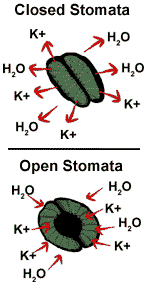
The opening and closing of the stoma is triggered by the blue light of the upcoming daylight. The receptors on the guard cells will sense the blue light and begin the pumping of hydrogen protons out of the guard cell. This leaves a negative charge in the cell and for positive potassium ions to enter the guard cell through channels in the membrane. The entrance of positive ions lowers the osmotic pressure causing water to move towards the high concentration of potassium ions in the guard cells. The large volume of water increases the hydrostatic pressure (turgor pressure) of the cell changing its shape and opening the stoma.
To close the stomata, the reverse process occurs.The potassium ions move out of the guard cell with water following. The loss of water causes the guard cell to become flaccid and the stomata to close. In extreme cases when the water level is low, the mesophyll cells can also release abscisic acid that triggers the stoma to close.

Abiotic Factors affecting Transpiration:
Light: blue wavelengths in daylight signals receptors to open the stoma
Humidity: the boundary surrounding the leaf creates the sub stomatal air space (SSAS). In high humidity there is a greater amount of water vapour in the SSAS so less water vapour will escape form the stomata. This is because there is little concentration difference of water between the SSAS and the leaf.
Wind: wind can blow away the water layer in the SSAS to increased the water vapour gradient between the leaf and SSAS. Transpiration increases with more wind
Heat: Liquid water turns into vapour with the rise in heat. High temperatures increase transpiration. 

Adaptations: 
Plants can make adaptations in response to their environments. 
Plants that make respond to dry environments are called Xerophytes. These plants will make adjustments in order to reduce water loss to combat the high temperatures and low levels of precipitation or in areas of high altitudes/latitudes where there is low precipitation or water is locked as ice or snow. 
Adaptatations of Xerophytes:
Waxy leaves: control water loss from epidermis of leaf in hot temperatures.
Rolled leaves: usually found in sand dunes habitat. It's difficult for soils to retain water so by rolling up the leaves the upper waxy epidermis is on the outside so the lower epidermis is enclosed. This allows humidity to build up on the inside and prevents wind, reduces evaporation and maintains the SSAS. The root hairs of the lower epidermis and the groove of the leaf will guide water to the stem/roots
Needle leaves: No lower epidermis. Entirely the waxy upper epidermis
Succulents (Cactus):leaves reduced to needles and stem is enlarged for water storage
Crassulacean acid Metabolism (CAM plants): plants with CAM opens their stomata at night rather than day to reduce water loss. Carbon dioxide can be combined with a C3 acid to be stored as a C4 acid until daytime where it is broken down into a C3 acid and carbon dioxide to be used. The stomata can be closed in the day.
Stomata in pits: stomata is surrounded by hairs and the pits to maintain SSAS layer of water vapour
Low growth: plants that grow closer to the ground will experience less wind or more shade.

Phloem:
transports sugars within plant from the source to a sink (storage area) or from sinks to other parts of plants.This movement is multidirectional and called TRANSLOCATION.
Companion cells not only provide energy for the sieve cell of the phloem, but they also load sucrose into the phloem until the phloem becomes hypertonic. The energy from the companion cells facilitates active transport of the sucrose into the phloem. Water follows the increased concentration of  sucrose and the turgor pressure increases. The water and sucrose they create a sap. When water follows the movement of the organic nutrients, it creates a pressure within the plant that explains the multidirectional nature of the phloem.

Support of Terrestrial plants:
Thickening of cellulose walls: the cells and xylem can be thickened to further support the plant.
Lignin Rings: xylem also has lignin rings for support
Turgor pressure: high concentration of water in plant cells increase support.


9.1 Plant Structure and Growth

Plant Structure and Growth:
Most plants are made up of similar components that help it survive within an environment. Sometimes these components can be altered slightly to maximize the lifespan of the plant in a more extreme environment.
Roots: the anchor system of the plant which is made up of the main root and the branches. They will have a large surface area to increase the absorption of water and minerals. .Roots will also store products of photosynthesis such as carbohydrates.

Stem: The stem forms the structure of the plant with branches extending from its sides. They will support leaves to help expose them to the sunlight.  The NODE is the point where the leaf attaches to the stem. INTERNODE is the space between two nodes on the stem. VASCULAR TISSUE transports the products of photosynthesis to various sinks where they can be stored. TUBERS, for example are stems that can store nutrients.
A version of the stem is the bulb. Bulbs are short stems that remain underground. They are usually quite fleshy to store much of the plant's nutrients.
Another version of the stem is called stolons or runners. These stems will extend horizontally from the main parts of the plant until it touches the ground and forms new roots and ultimately producing a new plant. They are also used to find new sources of water or nutrients.
Rhizomes also serve a similar purpose of runners except they are located underground. Another benefit of rhizomes are that these horizontal stems can survive underground when the environment is too cold or hot. Rhizomes can also store food, enlarge in size to become a tuber (eg. potato)
Cacti is a modified stem that is enlarged so that it can store water when water becomes scarce. The stem also takes over the leaf's job of photosynthesis while the leaves simply become spines to prevent water loss.
Tap roots are an extension of the root where water and food are stored. For example carrots are tap roots which store water but also helps stabilize the plant.

Leaves: the location where photosynthesis occurs. Absorbs CO2 and light from the environment. BLADE is the wide portion of the leaf making up its width. PETIOLE is the stalk between the leaf and the plant stem. LEAF AXIL makes up the angle between the petiole and the stem. The leaf has vascular tissue bundles that run along its surface in a vein like pattern.
On the underside of the leaf, there are openings called STOMATA which open and close depending on the guard cells that make up the hole.
Leaves can be modified to better support the plant. Some leaves have the ability to climb objects in order to maintain support or to expose themselves to sunlight. Other leaves such as the venus flytrap have hinges that allow them to shut and trap prey.                              


Leaf Tissue of a Dicotyledonous Plant

Upper epidermis: found on top of leaves where sunlight and heat are greatest. Function is to conserve water by secreting cuticle to form waxy layer
Palisade Mesophyll: found in the upper half of leaf. Used in photosynthesis, containing many chloroplasts. Water from the xylem will travel into the chloroplast
Spongy Mesophyll: Underneath Palisade Mesophyll, in the lower half of leaf near the stoma. The chloroplast cells are more loosely packed because this is where much of the gas exchange occurs. Gases can enter or exit plant through the stoma.
Together the spongy and palisade mesophyll make up the leaf parenchyma where carbohydrates made by photosynthesis can be stored then transported throughout the plant to make ATP.
Vascular tissue: Found in the middle of the leaf as well as much of the stem. Used to transport water (xylem) and products of photosynthesis (phloem)

Dicotyledonous and Monocotyledonous plants can be identified in various ways. The most obvious reason, as also stated in their names, would be the number of cotyledons that each type of plant has. Cotyledons are the first leaves found on the embryo of any spermatophytes (seed plants). They store and absorb food for the embryo before it is able to photosynthesize.

Plant Structure
Monocotyledons
Dicotyledons
Number of Cotyledons
One
Two
Leaf Veins
Parallel
Net like veins
Vascular Bundle Arrangement
Scattered
Ring
Flower Parts
Multiples of Three
Multiples of four or five
Aperture (Pollen Grain)
One Pores or Furrow
Three Pores or Furrows
Examples
Grasses, lilies, orchids (significant food sources eg. Corn, rice)
Dandelions, oak trees (more common)


Meristem: Embryonic tissue found in the stem and roots that will differentiate into three different types of plant tissues; Dermal, Ground and vascular tissues. Can be compared to the stem cells of humans
Dermal Tissue (epidermis): Waxy cuticle to cover to minimize water loss. Root hairs sometime pertruding to increase surface area for absorption of water and minerals and anchor plant
Ground tissue (only in dicots): makes up most of the plant tissue. It contains CORTEX which forms a ring along outer edge of the stem to help support plant stem and to maintain rigidity
Vascular bundles: Has xylem (water transport), Phloem (nutrients transport) cambium tissue (also known as lateral meristem that generates new tissues)
Xylem: is a vascular tissue that transports water and minerals that are lost during transpiration and photosynthesis in a plant. Made up of a series of cells without end walls to create a channel for water and minerals. These cells are tracheid or vessel elements. Tracheid cells allow water to flow through depressions/pits. Vessel elements are simply hollow cells with no end walls.
Phloem: transports organic nutrients such as sugars, amino acids, hormones and minerals, around the plant. Nutrients will be taken from photosynthetic areas to storage areas such as roots, tubers or bulbs or the opposite will occur where areas lacking nutrients can utilize the storage organs.  Uses Sieve cells and companion cells to transport materials. Sieve cells have sieve plates which are perforated. Companion cells simply aid sieve cells perform and they also have a nucleus whereas the sieve cells do not.

Xylem
Phloem
One Way Movement
Two Way Movement
Water and minerals
Nutrients
Continuous Cells with no end walls
Has End Walls with Perforations
Thick Walls Supported with Lignin
Companion Cells Support Sieve cells

Primary Plant Growth:
Plants will generally grow longitudinally due to the addition of cells at the tip of the roots. Apical meristem is found at the roots. This is the location where the plant is elongated when cells are added, specialized and matured.  Similarly, apical meristem is also found on the shoot of a plant to produce leaf primordia (immature leaves) along intervals of nodes.
Secondary Growth:
Secondary plant growth is the thicke
ning of a plant and hence the widening of branches and stems. This is usually found in dicots (few monocots) and is the result of two types of lateral meristems called vascular cambium and cork cambium. Secondary cork also forms wood and cork in 'woody' plants. The vascular cambium, that is located between xylem and phloem, will produce a secondary phloem and xylem to increase width. Cork Cambium replaces epidermis with cork that lies under the epidermis.

Apical and lateral meristems are both capable of division and differentiation and are found in dicotyledonous plants.
Differences:
Apical Meristem
Lateral Meristem
Found at tips of roots and shoots
Found at cambium
Adds vertical growth (length)
Adds lateral growth (Width, thickness)
Primary growth
Secondary Growth
Develops primary xylem and phloem
Develops secondary xylem and phloem
Produces new leaves and flowers
Produce bark or cork


The growth of a plant or its ability to photosynthesized can be influenced by external stimuli.
Tropism is the growth towards or away from a stimulus. Positive tropism is growth towards and negative tropism is growth away from the stimulus. Tropism is due to differential growth where one side of the plant grows faster than the other side causing the plant to bend. Hormones will regulate the response of the plant to a stimulus. Auxin is one such type that will promote growth in plants.
Auxin promotes cell elongation in response to a light stimulus. Auxin will move away from the light source and collect in the shady region. The cells will then elongate and the plant will bend towards the light source. Auxin is produced in the tip of the shoot or root by apical meristem. Specifically, auxin will bind to the receptor on a cell wall that triggers an ATP pump to make that cell wall acidic. The acidity activates enzymes to break the bonds of cellulose fibers within the cell wall and allowing the cell to expand. The change in concentration also creates a membrane potential across the cell wall and the diffusion of ions into the cell. Water quickly follows into the cell due to osmosis and increases the turgor pressure within the cell to further stretch the cell.


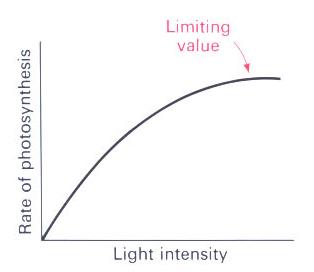
Other factors can also affect photosynthesis and growth. Ultimately one of these factors will limit the rate of photosynthesis. The one that is the slowest or has the lowest number will be the limiting factor.

Temperature: As temperature increases, so does the rate of photosynthesis. The temperature raises the kinetic energy of reactants so that photosynthesis will occur at faster rate until it reaches the maximum rate at the 'optimal' temperature. Beyond this temperature, the enzymes will denature and the rate of photosynthesis will decrease.


Concentration of CO2: The increased concentration of CO2 will increase the rate of photosynthesis until it reaches the plant becomes saturated with CO2. Further increase of CO2 will no longer affect the rate of photosynthesis. Different plants might require different amounts of CO2 for it to become saturated. In contrast with temperature, having too much CO2 will not cause a decrease in the reaction rate, but the rate will simply plateau and level out

Light Intensity: Low light intensities might not be sufficient for photosynthesis to occur, but the plant could still transpire. Similar to concentration, increases in light intensity will increase rate of photosynthesis until it reaches a plateau. Further increases beyond the optimal level of light will not the rate of photosynthesis, but can damage the chlorophyll systems or render the plant unable to harvest additional  light. The graphs of light intensity/concentration versus rate of photosynthesis will have similar structure.


10.3 Polygenic Inheritance

Polygenic Inheritance
     Certain characteristics are controlled by two or more genes. Many genes will play a part on the final characteristic of a trait. Polygenic inheritance usually follows a normal bell-shaped distribution curve with common characteristics in the middle and extreme characteristics at each side of the bell curve. With a greater number of genes controlling a trait, the number of phenotype combinations will also increase.
     An example of a characteristic that is controlled by multiple genes would be skin color. Human skin color changes depending on the amount of melanin present. The more melanin, the darker the skin. It has been discovered that at least 4 genes are involved in melanin production, where one allele of each gene will code for melanin production while the other allele will not. This combination of melanin producing alleles with non melanin producing alleles can result in a continuous variation of skin pigmentation.
     Similarly, the grain color in wheat also depends on multiple genes. The color of grain covers a range from white to dark red depending on the amount red pigment they contain. There are three genes with two alleles each that either code for the pigment or the lack of pigments. The most common genotype would have equal numbers of each allele. The most extreme genotypes would either have all pigment producing alleles, or all no pigment producing alleles.